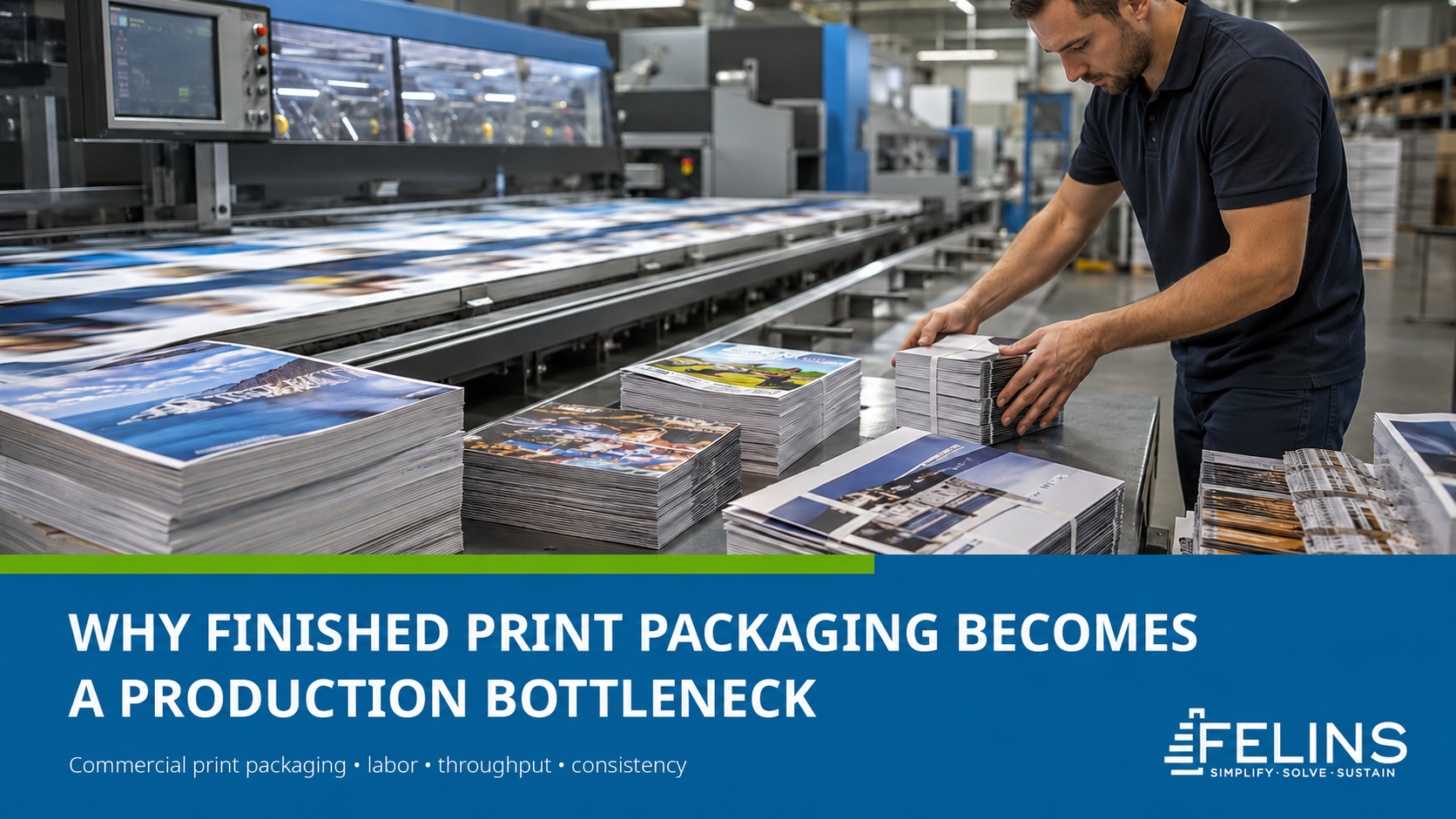
Commercial printers invest heavily in faster presses, automated finishing equipment and software designed to move jobs through production efficiently. Yet one of the most time-consuming steps may occur after the printing and finishing work is complete.
Before brochures, catalogs, direct-mail pieces, cards, manuals or other printed materials can be shipped, they often need to be counted, stacked, bundled, wrapped, labeled or boxed. When these tasks depend on manual labor, finished products can begin accumulating at the end of the production line.
The press may be ready for the next job, but the packaging team is still working through the last one.
As commercial printers face shorter runs, tighter turnaround expectations and a wider variety of finished products, eliminating bottlenecks in the finishing department has become increasingly important. Reducing manual touchpoints can improve consistency and help the rest of the workflow keep pace with modern print equipment.
CHALLENGE #1: THE PRESS IS FAST, BUT THE PACKAGING PROCESS IS STILL MANUAL
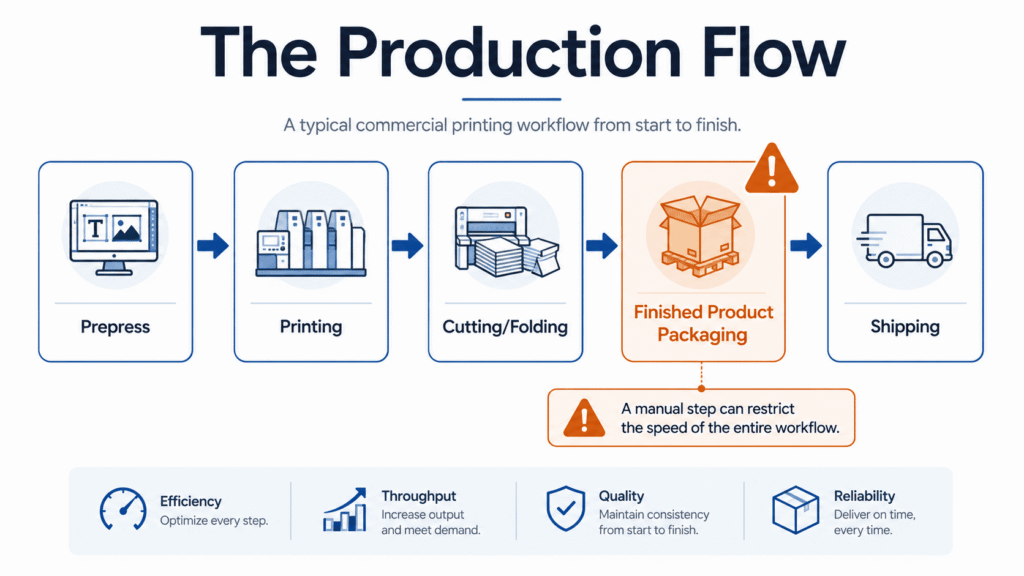
Print technology has become faster and more automated. Many commercial printers can move jobs efficiently through prepress, printing, cutting, folding and other finishing processes.
However, the final packaging step may still involve employees manually.
Manual packaging processes:
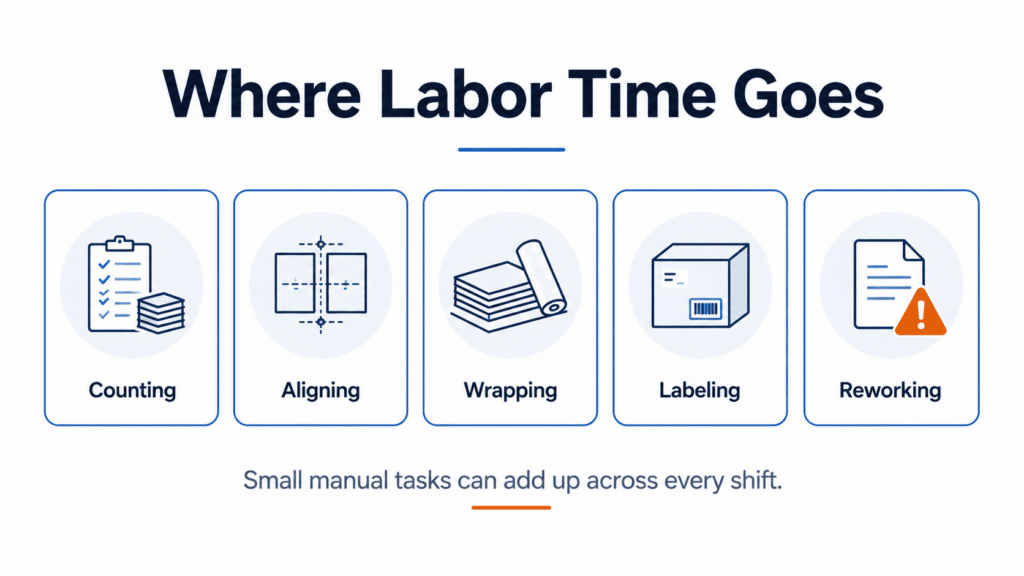
- Counting finished pieces
- Separating products into specific quantities
- Jogging and aligning stacks
- Applying straps, ties or rubber bands by hand
- Placing products into boxes
- Adding labels or identification sheets
Each individual task may appear manageable. The problem becomes more noticeable when hundreds or thousands of finished products arrive at the packaging area in a short period.
When packaging cannot match the output of the upstream equipment, work begins to queue. Employees may need to stop another task to help package finished products, or production may have to slow down until space becomes available.
CHALLENGE #2: PRINT PRODUCTS CAN BE DIFFICULT TO PACKAGE
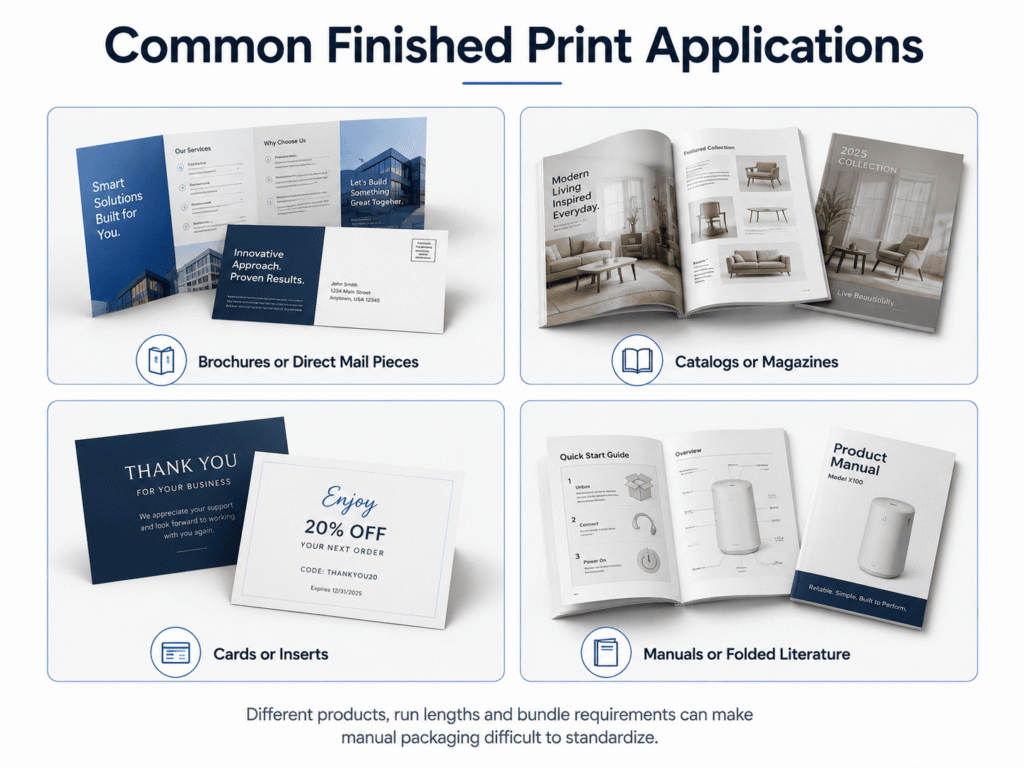
Commercial printers rarely produce only one type of product.
A packaging method that works for a thick stack of catalogs may not work as well for postcards, folded brochures, instruction manuals or delicate specialty pieces.
The packaging process may need to accommodate:
- Different product dimensions
- Frequent job changes
- Short and long production runs
- Varying stack heights
- Coated, glossy, or easily marked surfaces
- Products that shift or slide
- Customer-specific bundle quantities
This variability makes it difficult to use a one-size-fits-all packaging process.
Operators may need to adjust how each job is counted, handled and secured. Those adjustments take time and can make production output dependent on the speed and experience of individual employees.
The continued growth of short-run, personalized and versioned printing adds to this challenge. Modern commercial print workflows increasingly need to process more jobs with smaller quantities and faster turnarounds, making connected automation and efficient finishing processes more valuable.
CHALLENGE #3: MANUAL BUNDLING USES LABOR NEEDED ELSEWHERE
Manual packaging does not only affect production speed. It also determines how employees spend their time.
An operator may have to repeatedly pick up stacks, count pieces, straighten edges and apply packaging materials. During a high-volume job, one or more employees may spend hours completing these repetitive tasks.
Hidden labor costs include:
- Time spent correcting inaccurate bundle quantities
- Additional handling when stacks shift or come apart
- Supervisory time coordinating temporary labor
- Production delays while employees are reassigned
- Overtime required to finish urgent orders
- Opportunity costs when skilled employees perform repetitive work
Labor shortages remain an operational concern in printing and packaging, particularly for experienced operators, technicians and finishing personnel. This makes it increasingly important to use available employees where their skills create the most value.
Automating a repetitive packaging task does not necessarily mean eliminating a position. It can allow employees to focus on equipment operation, quality control, job preparation, maintenance and other responsibilities that require greater judgment.
CHALLENGE #4: INCONSISTENT BUNDLES CAN CREATE QUALITY ISSUES
The packaging step is often the final opportunity to protect the quality of a print job before it leaves the facility.
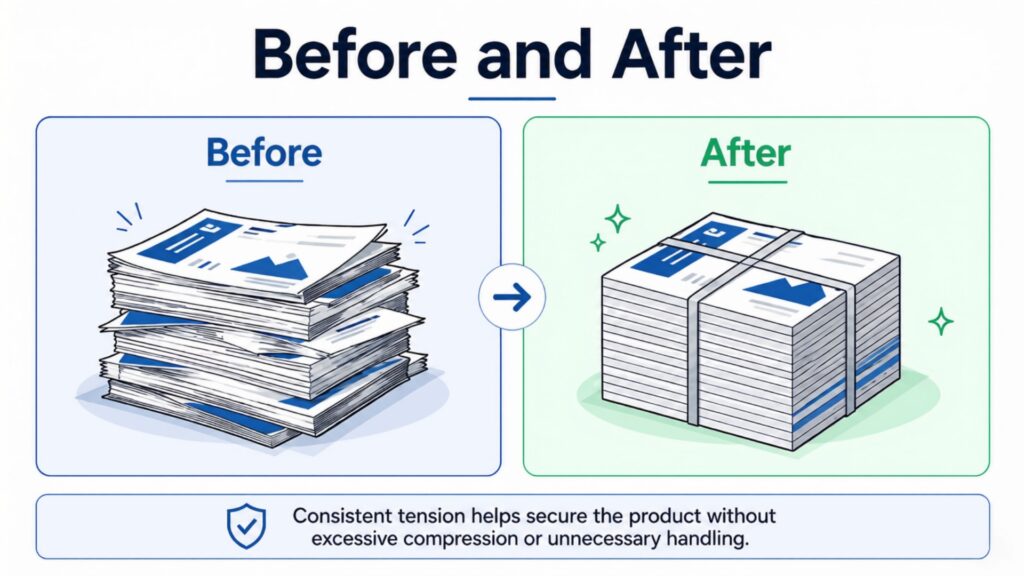
When bundles are created manually, the results can vary from one operator or shift to another. One bundle may be secured tightly, while another may be too loose. Quantities may also vary if employees count pieces manually or estimate stack sizes.
Inconsistent packaging can contribute to:
- Incorrect quantities
- Shifting or unstable stacks
- Bent corners and damaged edges
- Scuffing on printed surfaces
- Products becoming mixed between jobs
- Poor presentation when the customer opens the shipment
- Additional packaging or rework
A commercial printer may meet every color, registration and finishing requirement but still create a negative customer experience if the product arrives damaged or inconsistently packaged.
A repeatable bundling process helps ensure that the final package reflects the quality of the printed product inside it.
CHALLENGE #5: EXCESS PACKAGING IS ADDING COSTS
When a print product is difficult to secure, the default solution may be to use more packaging.
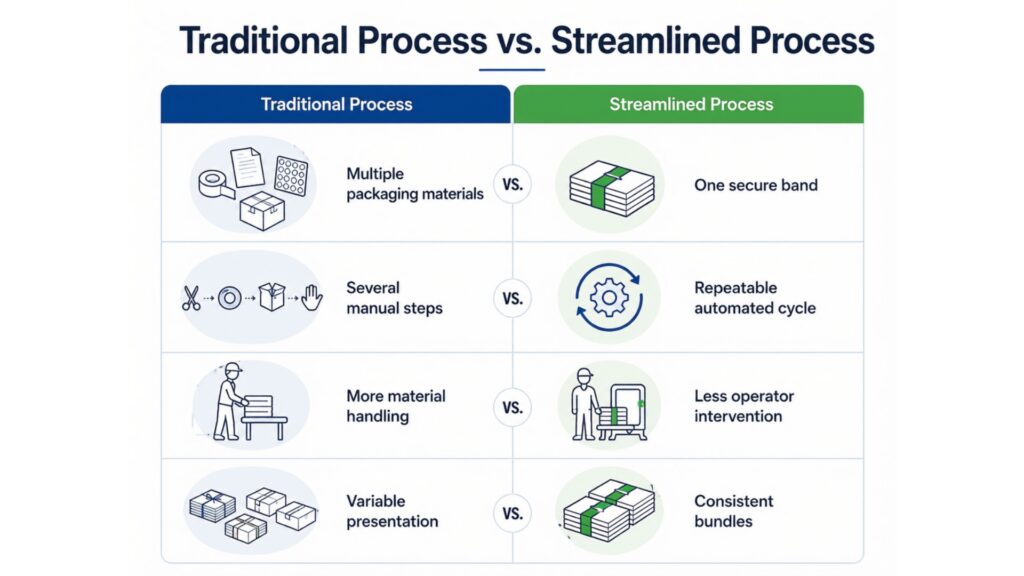
Employees may add multiple wraps of film, several straps, extra paper or a larger box to prevent movement.
These materials may solve the immediate problem, but they also increase packaging consumption and handling time.
Effects of excess packaging:
- Increased material costs
- Increased shipping weight
- Additional storage requirements
- Extra waste disposal
- Package appearance issues
- Sustainability goals are impacted
Some finished print products need the protection of a box or full wrap. Others may only need to remain securely grouped as they move to the next production stage, pallet or customer location.
Evaluating the purpose of the package can help determine whether the current method uses more material than the application actually requires.
SOLUTION #1: BANDING TECHNOLOGY HAS BEEN PROVEN TO IMPROVE THE PROCESS
Banding equipment is a popular solution for print industry businesses.
Automated and semi-automated banding secures a stack of printed products with a narrow band of material.
Depending on the application and equipment configuration, the banding process can be completed independently or integrated with counting, stacking, conveying or labeling systems.
Banding equipment can help commercial printers automate the end-of-line process cleaner and faster.
Benefits of banding equipment:
- Reduce repetitive manual bundling
- Create uniform, presentation-ready bundles
- Secure delicate products without excessive compression
- Process different product and bundle sizes
- Improve organization between production stages
- Improve consistency between employees or shifts
- Apply printed or variable information directly onto the stack (i.e. order number, customer name, job number, PO number, etc.)
Banding can turn a repetitive manual packaging step into a fast, consistent process.
For operations that process high volumes, automated feeding and stacking can further reduce manual handling. For printers with a diverse mix of shorter jobs, a semi-automatic or stand-alone banding machine may provide flexibility without requiring a fully integrated production line.
The best solution depends on the product, production speed, bundle quantity, level of automation and what happens to the product after it is bundled.
SOLUTION #2: IDENTIFY THE NEXT STEPS FOR YOUR FINISHED PRINT PACKAGING
Before selecting equipment, examine how products currently move through the facility.
The first step is to watch what happens after the product leaves the final finishing operation. If printed materials begin stacking up, employees are repeatedly pulled away from other responsibilities or packaging cannot keep pace with production, the final step may be restricting the entire workflow.
Start with these questions:
- Where do finished products accumulate?
Identify the point at which the workflow begins to slow down. - How many employees touch the product after printing?
Count every manual step, including stacking, transporting, wrapping and labeling. - Which products consume the most packaging time?
The highest-volume product may not always create the biggest labor burden. - How often do bundle sizes or quantities change?
Frequent changes may require equipment with flexible controls and fast setup. - Why is the product being packaged?
Determine whether the package is used for internal handling, shipping, retail presentation or customer-specific quantities. - What information needs to appear on the bundle?
Consider whether the band could also carry a barcode, job number, mailing information, branding or other variable data. - What production rate does packaging need to support?
The goal should be to balance the workflow rather than simply automate one isolated step.
SOLUTION #3: CONSULT WITH AN AUTOMATION SPECIALIST
Ready to Automate Your Finished Print Packaging Process?
Felins offers banding systems for bundling printed materials ranging from brochures and direct-mail pieces to catalogs, cards and other finished print products. Our team can evaluate your product, production rate and current packaging process to identify an appropriate level of automation.

REQUEST MORE INFORMATION
Tell us more about your packaging challenges. Our team will be in touch within 1 business day.

Joe McKillip
With 30 years of experience at Felins, Joe McKillip is a trusted expert in packaging automation and application development. He works closely with customers across a variety of industries to create efficient, customized packaging solutions that support both current needs and future growth.
Outside of work, Joe enjoys spending time with family, hunting, fishing, hiking and mountain biking.